

What we've shipped.
Four engagements. Sectors stay general, numbers stay real.
- FinanceChallenge
"The platform had been in development for a while. An approved report had not arrived yet."
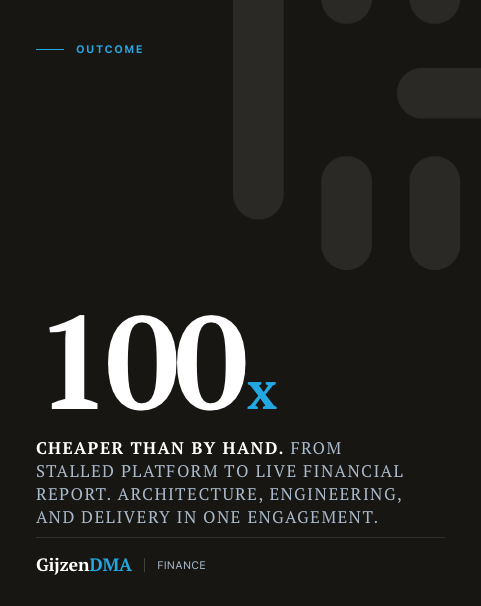
Outcome 100×Cheaper than by hand
NarrativeThe data platform had been in development for some time, but the first approved report had not materialised. We did a status assessment and proposed an alternative approach: Azure with its native tooling, used as intended. One month proof of concept: green light from finance and risk. Within 2 to 3 months the most important financial report was live. Fully automated, every day, where it had previously been done by hand.
"Finally."
- HealthcareChallenge
"The same manual work every day, and then hoping the numbers were right."
Outcome 3–4×Faster every day, with better quality
NarrativeReports were compiled by hand in Excel every day: pulling data from multiple sources, merging, checking, sending. Time-consuming and error-prone, repeated every working day. We brought the data sources together in Power BI and built automated reports that refresh themselves. The manual work disappeared. Reports now run before the first person sits down at their desk. Less time, fewer errors, and the people who used to do it spend that time on something more useful.
"I didn't know this was possible."
- AutomotiveChallenge
"We were migrating to the cloud, and bringing the old architecture with us."
OutcomeAdd new sources without writing code
NarrativeThe migration from Oracle to Azure Databricks was already underway, but the old architecture came along for the ride. Every new source required manually written, source-specific code. It did not scale. We advised on modern engineering principles: CI/CD automation, metadata-driven ETL patterns and generated code rather than hand-written logic. The result: a platform where adding a new source or table no longer requires a developer to write bespoke logic. The definition lives in the metadata; the platform handles the rest. Continuous improvement without the codebase growing in complexity alongside it.
"That's easy."
- RiskChallenge
"The same customer, three systems, three different IDs, and no way to connect them."
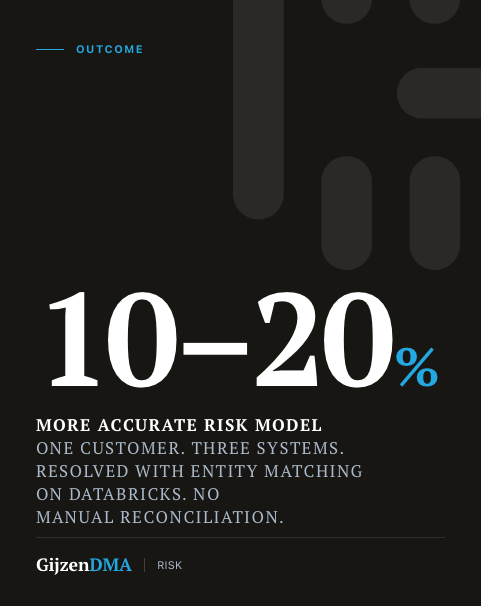
Outcome 10–20%More accurate risk model
NarrativeCustomer records were spread across multiple source systems, with different identifiers per system and over time. The same customer appeared as three separate records. Risk models were running on this fragmented data, which made them less accurate than they could have been. We built a platform extension on Databricks with a data lake as the foundation, and developed a multi-step matching logic that maps different customer IDs back to a single parent ID. Risk models now run on consolidated customer data. The improvement in model accuracy: 10 to 20 percent.
"This actually saves a lot of money."
Recognise any of this?
Tell us what you want to get out of your data and what's in the way. We'll tell you what we'd do.