
Start with the question.
Not the stack, not the vendor, not the hype. We don't put anything on the table until we understand what's there and what the ambition is. The right question at the start saves more time than any tool later.

We make sure the right work gets done at the right time. You don't need to keep track of who's on it. That is our responsibility. Here is how an engagement works.
Not the stack, not the vendor, not the hype. We don't put anything on the table until we understand what's there and what the ambition is. The right question at the start saves more time than any tool later.
What we build is yours: the code, the access, the documentation. We can maintain it for you if you want, but we always make sure you don't have to depend on us. You decide when you're done with us, not the other way around.
If the plan doesn't add up, we say so. If you want to build something you don't need, we'll say that too. We'd rather build less than build something that doesn't work, and we always explain why we recommend what we recommend.
Conversations with the people who work with it every day. Inventory of what's there, what's missing and what the ambition is. Only then do we put anything on the table.
A diagram, the chosen tools, the cost at current scale and as you grow. If it doesn't fit on one page, it isn't finished yet.
Iterative. The first working output comes in week one or two, not as a demo but as an actual product. That is how we test whether the assumptions hold before we build further.
We deliver with full documentation and a proper handover. After that you can run it, change it and explain it yourself. Want us to maintain it? We can do that, and you keep full access either way.
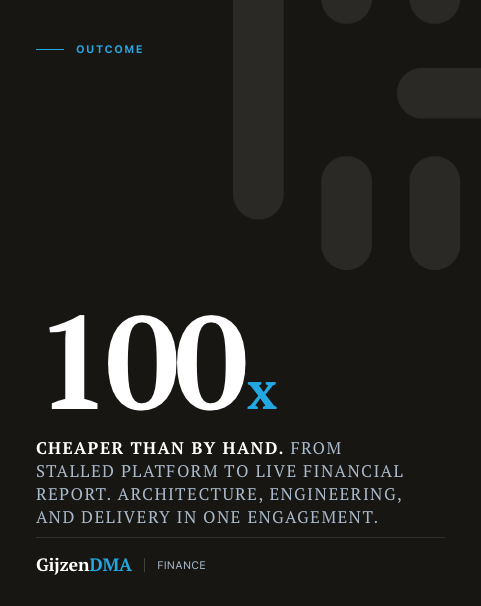
A financial organisation had a data platform in development, but the first approved report had not materialised. We did a status assessment and proposed an alternative approach. One month proof of concept: green light. Within 2 to 3 months the most important report was live — fully automated, every day.
Read the full engagement →Tell us what you want to get out of your data and what's in the way. We'll tell you what we'd do.